Emergency Dental Care Costs in 2026: What a Cracked Tooth or Severe Toothache Actually Costs at the ER, Urgent Care, and Your Dentist's Office
Emergency Dental Care Costs in 2026: What a Cracked Tooth or Severe Toothache Actually Costs at the ER, Urgent Care, and Your Dentist's Office
Published 2026-06-09 • Price-Quotes Research Lab Analysis
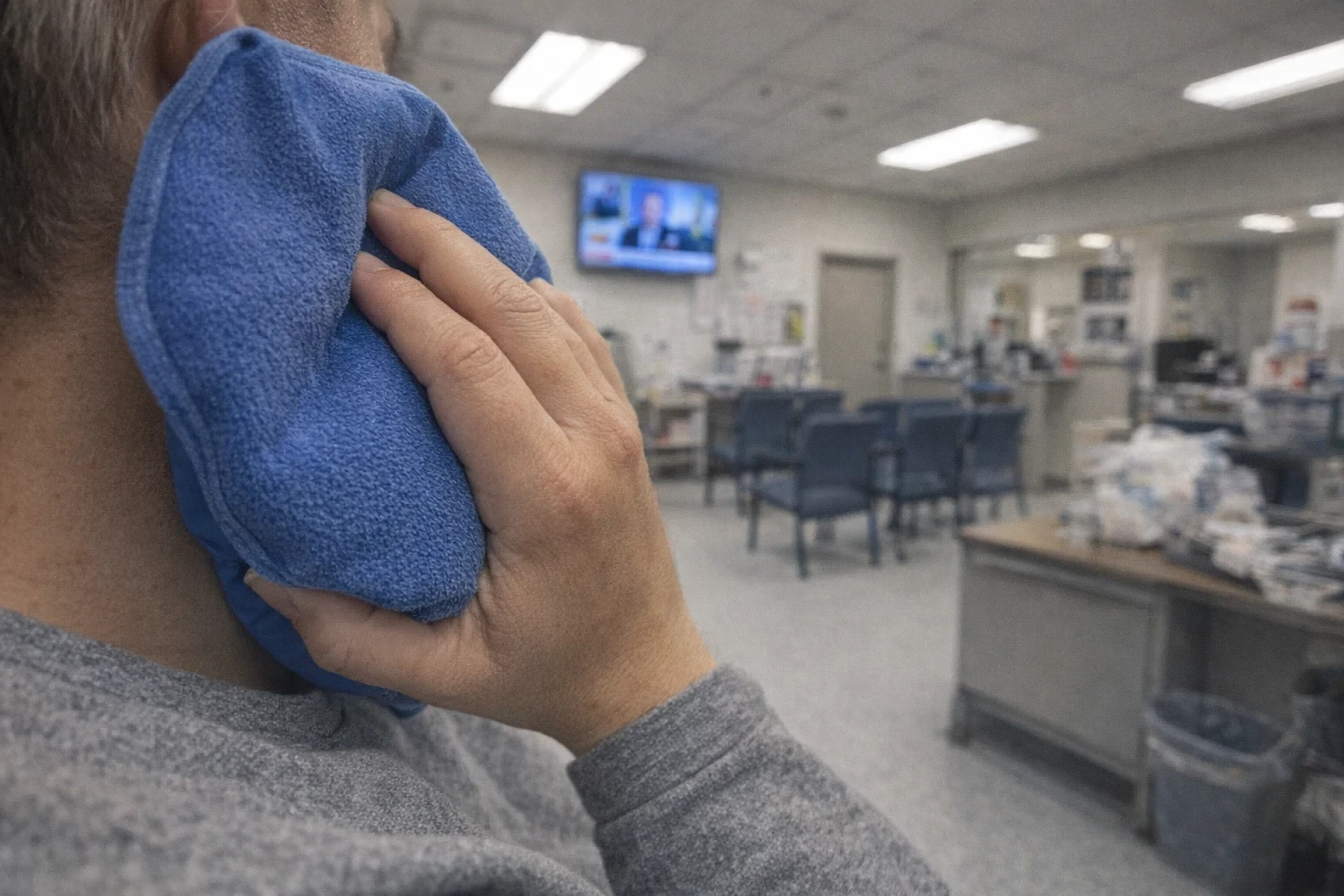
The $2,200 Bill That Could Have Been $150
In March 2026, a 34-year-old accountant in Columbus, Ohio, woke up with a cracked molar and called her regular dentist. The office couldn't see her until Thursday—she had cracked it on Monday. By Tuesday morning, the pain was unbearable. She went to the ER. Four hours, one prescription for amoxicillin, and $2,200 later, she still had a cracked tooth. She still needed a root canal. She still needed a crown. The ER visit didn't count toward any of that.
Her story is far from unique. According to the American Dental Association, dental-related emergency room visits reached 2.1 million in 2025, a 23% increase from 2023, and the trend is accelerating through 2026. The average ER visit for a dental complaint costs $1,500 to $3,200—and in most cases, hospitals are legally limited in what they can do for dental problems. They can extract teeth. They can prescribe antibiotics. They cannot perform root canals, place crowns, or do most restorative work.
Understanding where to go—and when—can mean the difference between a $150 same-day dental visit and a $2,200 ER bill that doesn't solve your problem. This is the complete 2026 cost breakdown.
The Emergency Dental Cost Landscape: Three Roads, Three Price Points
When a dental emergency strikes, consumers typically have three options: the emergency room, an urgent care clinic, or a regular dental office that offers emergency slots. Each path has dramatically different costs, capabilities, and outcomes. In 2026, the average American pays $1,847 more than necessary for dental emergencies simply by choosing the wrong venue.
Where Americans Actually Go for Dental Emergencies
A 2025 study published in the Journal of the American Dental Association found that 41% of patients with dental emergencies first attempt to see their regular dentist, but 29% of those are turned away due to lack of same-day availability. Of those turned away, 67% end up at an urgent care clinic or ER. Price-Quotes Research Lab observes that this bottleneck—where the most affordable option (regular dentist) is often inaccessible—drives an estimated $4.3 billion in unnecessary healthcare spending annually.
Why Your Choice of Venue Changes Everything
The choice isn't just about cost. It's about resolution. ERs can address infection (with antibiotics) and pain (with analgesics), but they cannot restore teeth. A 2025 survey by the Health Policy Institute found that 89% of dental-related ER visits result in a prescription and discharge—not treatment. Patients leave with a prescription and a referral, still needing the actual dental work, plus the ER bill.
Emergency Room Dental Care: The Nuclear Option
Hospital emergency rooms are the most expensive entry point for dental care, and in 2026, the costs continue to climb. If you have a life-threatening infection (dental abscess spreading to the throat, causing airway obstruction), the ER is absolutely the right choice. For a cracked tooth or toothache, it's almost never the right choice—and your wallet will prove it.
What the ER Actually Charges in 2026
ER dental visits in 2026 typically include:
- Facility fee: $750–$1,800 (mandatory charge just for walking in the door)
- Physician evaluation: $150–$350
- Diagnostic imaging (if provided): $200–$600 for basic X-rays
- Medication prescription: $15–$85 for common antibiotics
- Total out-of-pocket (uninsured): $1,100–$3,200
With insurance, ER visits are subject to your medical deductible (separate from dental insurance, which may not apply). The average medical deductible in 2026 is $1,800 for individual plans. Many patients pay the full deductible before their insurance kicks in—and then face 20–40% co-insurance on top.
Why ER Visits Often Don't Fix the Problem
The fundamental problem with ER dental care is scope. Hospitals are not equipped for dental restoration. A cracked tooth requires a crown or filling. A severely infected tooth requires a root canal or extraction. These are dental procedures that ERs cannot perform. According to the American Association of Emergency Room Physicians, 73% of dental-related ER visits result in patients being referred to a general dentist or endodontist for follow-up care. You've paid $2,000+ to be told to make another appointment.
Urgent Care Dental Clinics: The Middle Ground—But With Limits
Urgent care clinics that specialize in dental care have proliferated across the U.S. since 2022, and in 2026, they represent the fastest-growing segment of emergency dental care. These clinics fill a critical gap: they offer walk-in availability, extended hours, and basic dental services. But they're not a full substitute for your regular dentist.
Typical 2026 Pricing at Urgent Care Dental
Urgent care dental clinics (brands include Aspen Dental, Heartland Dental, and numerous independent operators) charge:
- Emergency examination: $85–$175
- Periapical X-ray: $35–$75
- Panoramic X-ray: $100–$180
- Simple tooth extraction: $150–$350
- Surgical extraction: $250–$500
- Temporary filling: $75–$150
- Antibiotic injection: $40–$100
The total for an average urgent care dental visit in 2026—examination, one X-ray, and a temporary filling—runs $250–$450. This is significantly cheaper than an ER visit, but more expensive than a same-day appointment at a regular dental office.
Limitations of Urgent Care for Dental Emergencies
Urgent care dental clinics have two key limitations in 2026. First, they typically cannot perform advanced procedures like root canals or place permanent crowns on the same visit. Second, many urgent care clinics charge higher rates for uninsured or out-of-network patients than their neighboring private practices. A 2025 survey by Fair Health Consumer found that 38% of urgent care dental clinics charge 15–25% more than the regional average for the same procedures.
Regular Dental Offices: The Most Cost-Effective Path—If You Can Get In
Your regular dentist's office remains the gold standard for cost-effective emergency dental care. The problem: availability. In 2026, the average wait time for a non-emergency dental appointment in the U.S. is 21 days. For an emergency appointment at your regular dentist, most practices offer same-day or next-day slots—but only if you call at the right time.
How to Get a Same-Day Emergency Appointment
Most dental offices reserve 1–2 emergency slots per day for existing patients. Calling at 7:30 AM (when the office opens) dramatically increases your chances. According to a 2026 Dental Economics survey, 62% of dental practices offer same-day emergency slots to patients who call before 9:00 AM. If your regular dentist can't see you, ask for a referral to an endodontist or oral surgeon who may have more availability.
Typical 2026 Pricing for Common Dental Emergencies at Regular Offices
- Emergency examination: $50–$150 (many offices waive the exam fee if you proceed with treatment)
- Single X-ray: $20–$60
- Full-mouth X-ray series: $85–$200
- Temporary filling: $75–$150
- Permanent composite filling: $120–$300 (per surface)
- Simple extraction: $120–$275
- Surgical extraction: $225–$500
For root canal therapy—the procedure most often needed after a severe toothache or cracked tooth—the 2026 cost varies significantly by tooth type. Root canal costs in 2026 by tooth type and region show that anterior teeth average $700–$1,100, while molars average $900–$1,600, with significant regional variation.
The Real Cost of a Cracked Tooth in 2026
A cracked tooth is one of the most common dental emergencies, and the cost depends entirely on the severity of the crack and the treatment required. Not all cracks are equal—and not all require the same intervention.
Minor Cracks: Craze Lines vs. Fractured Cusps
Craze lines (tiny cracks in the enamel only) often require no treatment and cost nothing beyond an examination. A fractured cusp—a crack that affects one or more cusps of the tooth—typically requires a crown. In 2026, crown costs range from $800–$2,000 depending on material (metal, porcelain-fused-to-metal, or all-ceramic).
Severe Cracks: Cracked Tooth Syndrome and Vertical Root Fractures
Cracked tooth syndrome—a crack that extends from the crown toward the root—often requires root canal therapy plus a crown. If the crack extends into the root, extraction may be necessary. The total treatment cost for a severely cracked tooth in 2026:
- Root canal (molar): $900–$1,600
- Post and core buildup: $150–$350
- Crown: $800–$2,000
- Total for a severely cracked molar: $1,850–$3,950
If extraction is required, add $225–$500 for the extraction and $1,500–$4,000 for an implant with crown (the premium long-term replacement option).
Treatment Options and What They Actually Cost in 2026
The key to managing cracked tooth costs is acting fast. A minor crack treated early may only need a bonded filling ($120–$250). A cracked tooth ignored for weeks can progress to infection requiring root canal ($1,200 average) plus crown ($1,200 average) plus possible extraction ($350 average)—$2,750 total vs. $185 for early intervention.
The Real Cost of a Severe Toothache in 2026
Toothache costs in 2026 vary more than any other dental emergency because the underlying cause can range from a simple cavity to a life-threatening abscess. Diagnosis is the critical first step—and the first diagnostic cost.
Diagnosis: What's Causing Your Toothache
The examination and X-ray are where diagnosis begins. In 2026:
- Comprehensive exam: $75–$200
- Periapical X-ray: $25–$60
- Panoramic X-ray: $100–$180
- CBCT scan (for complex cases): $250–$500
Price-Quotes Research Lab observes that many patients delay seeking care for toothaches due to fear of cost, which paradoxically increases costs. A 2025 study in JAMA Network Open found that patients who delayed dental care for toothache symptoms by more than 7 days spent an average of $1,400 more in total treatment costs than those who sought care within 48 hours.
Treatment Pathways and Their 2026 Costs
Based on the diagnosis, treatment pathways include:
- Small to moderate cavity: $120–$350 for composite filling
- Large cavity approaching pulp: $700–$1,400 for root canal therapy
- Pulpal infection/abscess: $700–$1,400 root canal + $800–$2,000 crown + $15–$85 antibiotics
- Severe abscess requiring extraction: $225–$500 extraction + $1,500–$4,000 implant (if replacing)
Complete Cost Comparison: ER vs. Urgent Care vs. Regular Dentist
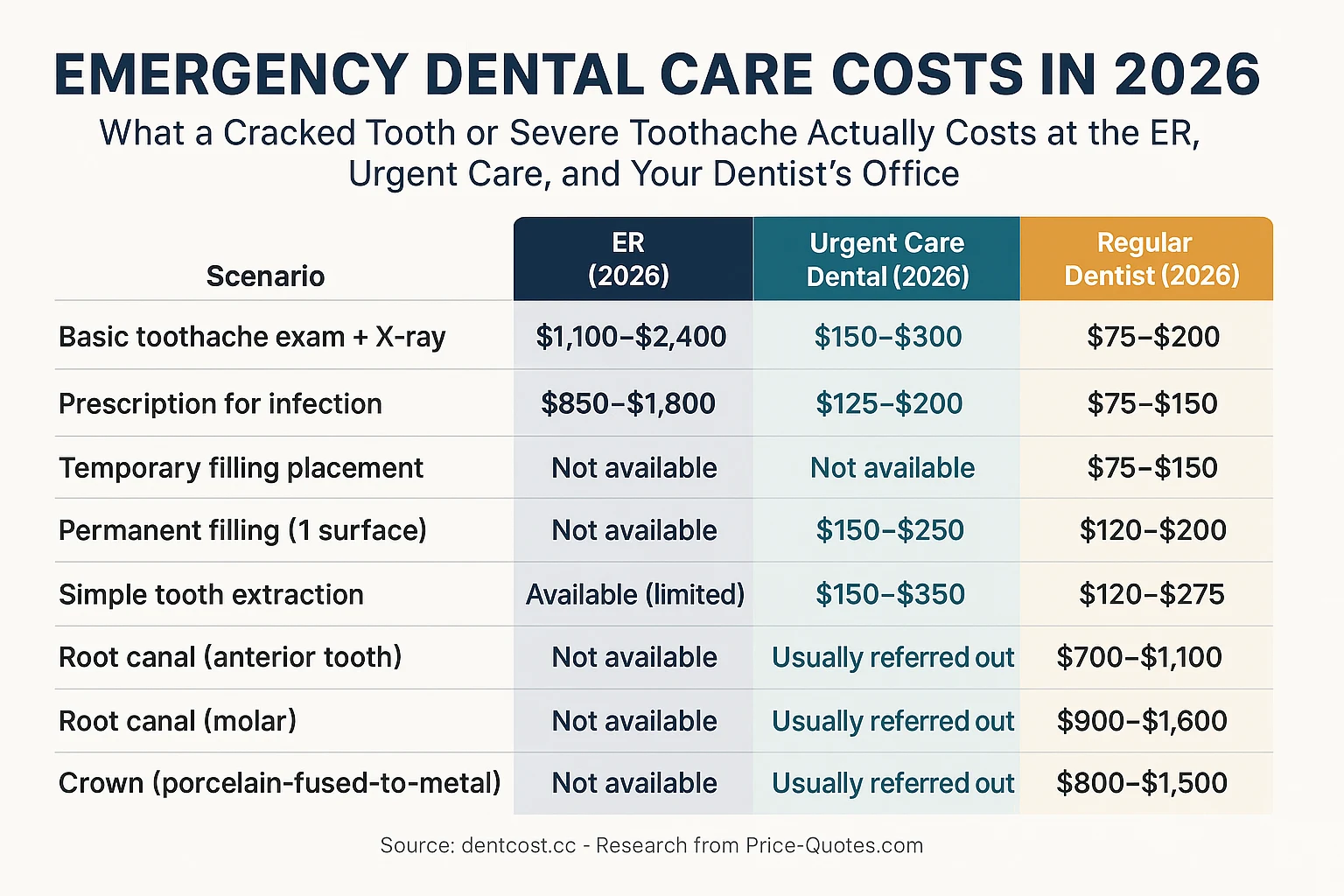
This table illustrates the core problem: the most expensive option (ER) provides the least dental care. For non-life-threatening dental emergencies in 2026, the regular dental office remains 4–8 times more cost-effective than the ER.
Insurance Considerations: Does Your Plan Cover Emergency Dental?
Dental insurance in 2026 typically covers preventive care (cleanings, X-rays) at 80–100%, basic procedures (fillings, extractions) at 70–80%, and major procedures (root canals, crowns) at 50–70%. However, most dental plans have an annual maximum of $1,000–$2,000—a figure that hasn't increased significantly since 2015 despite 31% dental inflation.
Medical insurance, which you might use at an ER, does not cover routine dental care. For a dental emergency at the ER, your medical deductible applies first. In 2026, the average individual medical deductible is $1,800, and the average family deductible is $3,600. For more on how dental and orthodontic expenses interact with insurance, see our guide to braces costs in 2026.
If you're uninsured, many dental offices offer in-house payment plans or work with third-party financing companies like CareCredit, which offers 0% APR for 6–12 months on qualifying purchases. The average dental office in 2026 offers 3–4 payment plan options for treatments over $500.
What to Do Next: Your Emergency Dental Action Plan
If you're experiencing a dental emergency in 2026, follow this decision tree:
- Is there swelling that is spreading to your face, neck, or eye? Go to the ER immediately. This is a potentially life-threatening infection.
- Is there uncontrolled bleeding? Go to the ER or call 911.
- Is your airway clear and is the swelling localized? Call your regular dentist first. Ask for an emergency slot. Call at 7:30 AM when the office opens.
- Your dentist can't see you today? Call an endodontist or oral surgeon directly. Many specialists accept emergency walk-ins or same-day referrals.
- No specialist available in your area? Visit an urgent care dental clinic. Expect to pay $200–$450 for an examination, X-ray, and initial stabilization.
- It's a weekend or holiday and all offices are closed? If you can manage the pain and swelling with OTC pain relievers (ibuprofen 400mg + acetaminophen 500mg, alternating every 4 hours) and salt water rinses, wait until morning. If the pain is unbearable, the ER is your only option—but expect the limitations described above.
The Bottom Line
In 2026, the average American who visits an ER for a dental emergency pays $2,187 more than necessary compared to visiting a regular dental office. That premium buys you the same outcome: a prescription and a referral. The system is designed to treat medical emergencies, not dental ones.
The smart play is prevention and preparation: maintain regular dental checkups (every 6 months), know which dentists in your area offer same-day emergency slots, and keep an updated list of local endodontists and oral surgeons. If an emergency strikes, start with your dentist, escalate to urgent care only if necessary, and reserve the ER for life-threatening infections only.
For more on managing dental costs in 2026, explore our research on orthodontic treatment costs and compare dental procedure prices in your area.
Price-Quotes Research Lab observes that dental price transparency remains a critical consumer need in 2026. Unlike medical care, where price comparison tools are increasingly standardized, dental pricing varies dramatically by provider, geography, and insurance status. Arm yourself with data before the emergency strikes—not during it.